Leave Your Message

What Is the Best PE Extrusion Line to Buy in 2026?

Choosing the best Pe Extrusion Line in 2026 is not simply a contest of advertised output. A line rated for high throughput can still waste resin if its screw, die, and cooling system are poorly matched. The resin grade matters. So do pipe dimensions, wall-thickness tolerances, shift patterns, and available floor space. Small details show up quickly: unstable melt pressure, uneven cooling, or frequent screen changes can cut into usable production time.

Industry data provides context, not a machine-buying shortcut. Plastics Europe’s Plastics the Fast Facts 2024 reports global plastics production of 413.8 million tonnes in 2023. That figure covers plastics overall, not polyethylene alone. Buyers should avoid treating it as a forecast for PE equipment demand. For technical perspective, extrusion specialist Dr. Chris Rauwendaal’s published work emphasizes matching screw design and processing conditions to the polymer. Put plainly, buy for the resin and product—not the brochure’s maximum-speed figure. This is a paraphrase, not a verbatim quotation.

A sound 2026 comparison should examine demonstrated output, energy use per kilogram, changeover time, scrap rates, automation, and access to spare parts. Ask suppliers to run your actual PE grade and document the settings. Request data from a sustained production trial, not a brief demonstration. Check the downstream haul-off, cooling, and cutting equipment too; a fast extruder cannot rescue a bottlenecked line. And be candid about uncertainty. Resin formulations, operators, and plant conditions vary, so one test cannot promise identical results everywhere. That caveat matters. The sections ahead compare line configurations, supplier evidence, and lifecycle costs, helping buyers choose a Pe Extrusion Line that fits their real production targets.

What Is the Best PE Extrusion Line to Buy in 2026?

What a PE Extrusion Line Is and How It Works

What Is the Best PE Extrusion Line to Buy in 2026?

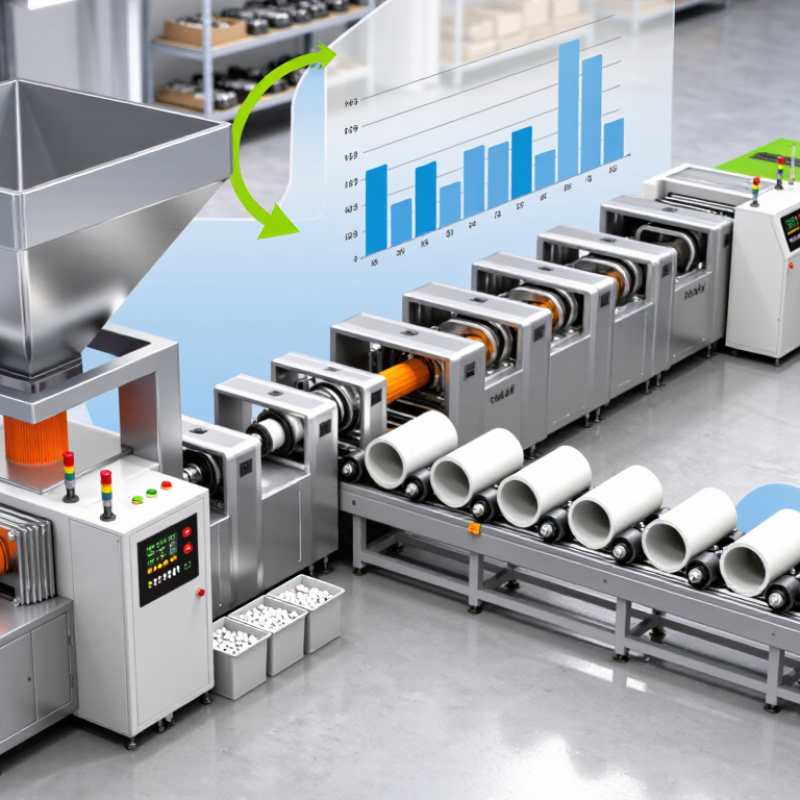
A PE extrusion line converts polyethylene resin into continuous products such as pipe, film, or profiles. The process starts when resin pellets enter a heated barrel. A rotating screw moves, mixes, and melts them. The molten plastic then passes through a die, which shapes it into the required form. That is the path.

For pipe production, a calibration unit helps hold the pipe’s dimensions as vacuum and cooling tanks set its shape. A haul-off pulls the product forward at a controlled speed. A cutter or coiler handles the finished length. Each section affects the next: uneven cooling, for example, can contribute to ovality or inconsistent dimensions. Line performance also depends on resin grade, output targets, die design, and operating settings. A specification sheet alone may not reveal how a line behaves during a sustained production run.

Tips: Match the screw and die to your resin and product dimensions. Ask for measured output and sample-product checks at your target speed. Small changes matter. Review maintenance access and cooling capacity, too; these are easy to overlook when comparing equipment.

What Is the Best PE Extrusion Line to Buy in 2026?

Typical HDPE Pipe Extrusion Temperature Profile

PE extrusion lines melt and shape polyethylene through a sequence of heated barrel zones before the material passes through an adapter and die. The ranges shown are illustrative operating setpoints for HDPE pipe extrusion, not universal specifications. Actual settings depend on the resin grade, line design, output rate, and product requirements; follow the resin supplier’s and equipment manufacturer’s guidance.

Main Types of PE Extrusion Lines and Their Applications

PE extrusion lines serve different jobs, so the best choice in 2026 depends on the product, resin, and target output. Pipe lines produce water, drainage, and gas pipes in varied diameters. Their sizing tanks, vacuum calibration, and haul-off units affect roundness and wall consistency. For large pipes, check floor space and cooling capacity, not just the extruder’s rated output.

Blown-film lines suit packaging films and agricultural covers, while cast-film lines can deliver more uniform thickness for specific packaging uses. Sheet and profile lines handle items such as protective panels, edging, and custom sections. On a production floor, small changes in melt temperature can show up as uneven film or a rough pipe surface. A fast line is not automatically the right line; tooling changes, scrap rates, and operator training matter too. Specifications can look impressive on paper, yet need confirmation with your intended PE grade.

Tips: Ask for a trial using your resin and product dimensions. Measure output, thickness variation, and startup waste. Check whether common wear parts are available locally. Leave room for future tooling; that detail is easy to overlook.

What Is the Best PE Extrusion Line to Buy in 2026? — Main Types of PE Extrusion Lines and Their Applications

PE Extrusion Line Type Typical Products and Configurations Main Applications Key Buying Considerations for 2026 Best Fit
PE Pressure Pipe Line HDPE and PE pipe for water, gas, irrigation, and industrial services. Available in different diameter and pressure classes; configurations may include single-layer or co-extrusion systems. Municipal water distribution, approved gas networks, agricultural irrigation, drainage, and industrial fluid conveyance. Match the diameter range and pressure-class requirements to the intended market. Assess output stability, wall-thickness control, sizing and cooling capacity, haul-off performance, cutting method, and applicable product standards. Producers targeting infrastructure, utility, or irrigation projects.
PE Corrugated Pipe Line Single-wall or double-wall corrugated pipe, often produced with a forming machine and dedicated cooling and cutting equipment. Product diameters and structures depend on the line design. Underground drainage, stormwater management, cable protection, and non-pressure conduit applications. Confirm the required pipe structure, diameter range, ring-stiffness target, mold availability, forming speed, and cooling capacity. Check that the line can consistently produce the required jointing and connection features. Businesses focused on drainage, conduit, or infrastructure pipe rather than pressure pipe.
PE Blown Film Line Single-layer or multilayer blown film, including co-extrusion configurations. Layflat width, film thickness, layer structure, and output are selected to suit the product and resin blend. Packaging film, liners, agricultural film, construction covers, and bags converted from film. Prioritize the required film width and thickness range, number of layers, bubble stability, gauge control, winding quality, and resin compatibility. Evaluate energy use and the automation needed for changeovers and quality monitoring. Converters and packaging producers that need flexible film formats or multilayer structures.
PE Sheet and Geomembrane Line Flat PE sheet or geomembrane, with line width, thickness, surface finish, and winding or stacking arrangement designed for the product specification. Landfill and pond liners, containment systems, protective panels, and industrial sheet products. Check usable sheet width, thickness capability, die and roll design, cooling and edge-trimming systems, surface consistency, and winding or stacking limits. For geomembrane, verify that inspection and testing processes meet the target specification. Producers serving environmental containment, construction, or industrial sheet markets.
PE Profile Extrusion Line Custom PE profiles such as ducts, channels, protective components, and other continuous cross-section products. Tooling is specific to the profile design. Cable and utility protection, construction components, transport products, and application-specific parts. Review profile geometry, dimensional tolerances, die design, calibration method, cooling length, haul-off control, and the ease of changing or maintaining tooling. Request a trial using the intended resin and product design. Manufacturers with a defined custom-profile product and repeatable demand.

Selection note: There is no single best PE extrusion line for every buyer. Choose a line based on the product specification, target market, resin grades, required output, local standards, available floor space, utilities, and service support. Capacity and product ranges are configuration-dependent; confirm them against a written technical proposal and product trial.

Key Specifications to Compare When Buying in 2026

When comparing PE extrusion lines in 2026, assess output using your actual resin grade, pipe diameter, and wall thickness—not a brochure’s maximum. PlasticsEurope’s Plastics—The Fast Facts 2024 reports 413.8 million tonnes of global plastics production in 2023. At that scale, repeatable processing matters more than a brief peak-rate claim. Ask for continuous output in kg/h, melt-pressure variation, dimensional tolerance, and scrap rate during an extended run. That test matters.

Compare screw design and length-to-diameter ratio, drive torque, and specific energy use in kWh/kg at matched output. The U.S. Department of Energy’s motor-systems sourcebook estimates that motor-driven systems use about 54% of U.S. manufacturing electricity; that broad figure is not extrusion-specific, but it makes line-level energy testing worthwhile. Check feeder accuracy, vacuum-tank capacity, cooling performance, haul-off grip, cutter speed, and changeover time against your product range. Request operating logs, not assurances. Confirm alarm records, spare-part lead times, and operator training. A high nominal capacity can still mean lost hours during grade changes. I would also question whether quoted tolerances hold over a long production run; that answer may be less tidy than the sales sheet.

How to Assess Manufacturers, Service, and Total Ownership Cost

For a 2026 PE extrusion line, assess the supplier beyond quoted output and installed price. Plastics Europe’s Plastics—The Fast Facts 2024 reports global plastics production of 413.8 million tonnes in 2023. That scale signals a mature, competitive market, but it does not prove demand for your specific pipe or film. Request a witnessed trial using your resin grade, recycled-content blend, and actual product dimensions. Record stable output, melt temperature, scrap rate, and changeover time. Small print matters. Ask for references from plants running comparable dies and shifts, plus written commitments for response times, training, and critical spare parts.

Build a five-to-ten-year ownership model, not just a purchase comparison. Include energy, labor, tooling, screw and barrel wear, maintenance, commissioning, financing, and lost production during service. Compare kilowatt-hours per kilogram using the same resin and throughput; otherwise, the result can mislead. Ask the manufacturer to disclose the uptime and operating conditions behind any performance guarantees. A lower-priced line can become costly when technicians wait days for parts. Conversely, premium automation may add little value if changeovers are rare. Keep an allowance for unknowns: even careful estimates can miss awkward start-up losses. Check whether warranty exclusions cover normal wear items and process changes. This is where buyers often under-budget.

How to Match a PE Extrusion Line to Production Requirements

Choosing a PE extrusion line starts with the product, not the machine’s headline output. A pipe line needs stable melt pressure, accurate sizing, and dependable vacuum calibration. Film production places greater weight on die width, cooling, and winding control. Different jobs. Different bottlenecks.

Plastics Europe reported 400.3 million tonnes of global plastics production in 2022 in Plastics—The Fast Facts 2023. That figure covers all plastics, not PE alone, but it shows the scale of a competitive market.

Specify your real operating target: kilograms per hour, product dimensions, resin grade, shifts, and expected changeovers. Ask suppliers to demonstrate output using your intended resin and tooling, not just a favorable test material.

Check the whole line. A fast extruder cannot compensate for an undersized cooling tank, haul-off, cutter, or winder. Compare energy use per kilogram, scrap during startup, and access for screw and die maintenance. Leave room for a small buffer in downstream capacity. A spreadsheet can still mislead: nominal output may assume ideal conditions and uninterrupted running. Ask for measured production data, tolerances, and the test conditions behind each figure before comparing quotations.