Electric motors quietly drive factories, pumps, compressors, elevators, and thousands of machines. Their performance depends heavily on the conductor inside each stator slot. This is where Motor Winding Cable becomes critical.
The International Energy Agency has reported that electric motor systems use roughly half of global electricity. That figure explains why winding materials deserve closer technical attention. A small insulation defect can create heat, vibration, and costly production downtime. A reliable supplier must therefore offer more than copper or aluminum conductors. It should demonstrate controlled insulation thickness, stable thermal performance, dimensional accuracy, and traceable testing.
Industry research from Grand View Research and MarketsandMarkets identifies continued growth in electric motors, driven by industrial automation, electric vehicles, renewable-energy equipment, and efficient appliances. These sectors demand winding products with stronger thermal endurance and tighter manufacturing tolerances. Standards such as IEC 60317 and NEMA MW 1000 provide useful reference points, although buyers should still verify application-specific approvals.
This guide examines ten leading Motor Winding Cable suppliers worldwide. The comparison considers manufacturing scale, product range, insulation technologies, certifications, delivery capability, and evidence of long-term customer support. Public rankings can be imperfect. Supplier strengths also vary by region, voltage class, conductor material, and motor design. A company excelling in high-temperature traction motors may not suit a small industrial fan.
Real purchasing decisions need testing. Datasheets alone are not enough. Engineers should review sample coils, thermal-aging results, dielectric breakdown values, and batch traceability before approval. The selected suppliers represent influential market participants, but readers should reassess every option against their own operating conditions. That practical step is often overlooked.
Electric motors consume about 45–46% of global electricity, according to the International Energy Agency’s Energy Efficiency 2018 report. This demand makes motor-winding wire a major efficiency component, not a minor purchasing detail. A thin enamel defect can create heat, vibration, and early insulation failure inside a tightly packed stator.
The U.S. Department of Energy’s Motor Systems Market Assessment also reports that motor systems use roughly 70% of industrial electricity. Therefore, buyers comparing the top 10 global motor-winding cable suppliers should examine more than price. Important checks include copper purity, conductor tolerance, insulation temperature class, dielectric strength, thermal aging, and batch traceability. Compliance with IEC 60317 and IEC 60034 requirements can provide a stronger technical baseline.
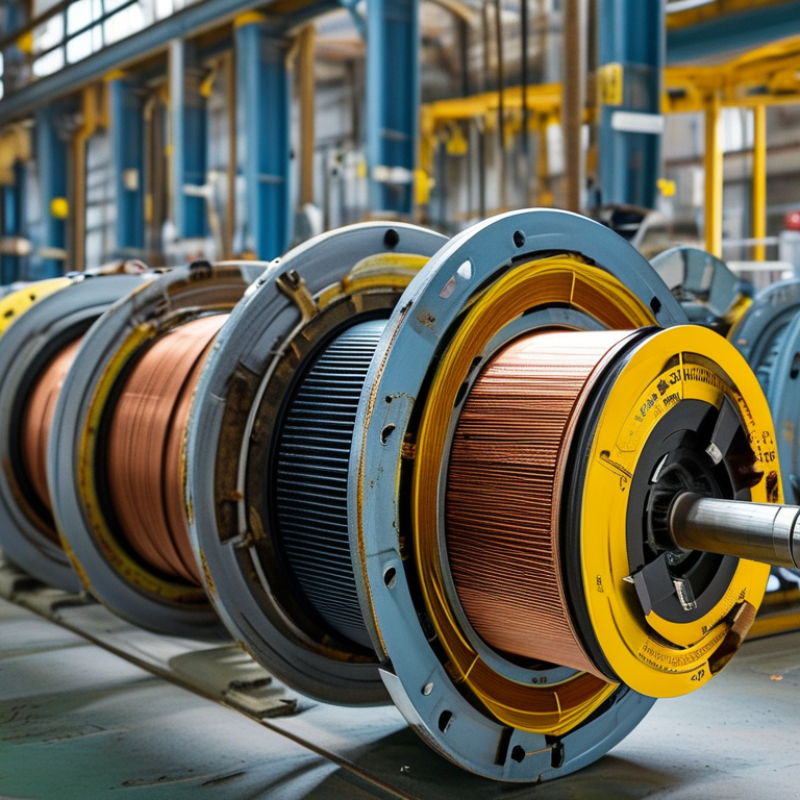
In factory inspections, winding wire quality becomes visible through smooth enamel surfaces, consistent dimensions, and clean pay-off during coil insertion. Production engineers should request test certificates and sample coils before approving large orders. Supply resilience matters too, especially for copper availability and delivery consistency. However, the 46% figure is not perfectly uniform across every study or region. It changes with industrial structure, motor definitions, and measurement methods. That limitation deserves attention. Efficiency gains also depend on the motor design, winding process, operating load, and maintenance—not wire alone.
Global Motor-Winding Wire Market: Motors Consume About 46% of Electricity
This benchmark compares standardized copper conductor sizes commonly used in motor-winding and motor-supply cable designs. Values represent the maximum DC resistance at 20°C in accordance with IEC 60228; larger conductor cross-sections generally provide lower resistance and reduced electrical losses.
Choosing among the top ten motor winding cable suppliers requires more than comparing price or delivery speed. The International Energy Agency reports that electric motor systems consume roughly half of global electricity. Small insulation failures can therefore create significant maintenance and efficiency costs. Supplier audits should begin with IEC 60317 certificates, production traceability, and recent electrical test records.
IEC 60317 defines enamelled winding wire dimensions, coatings, and performance tests. NEMA MW 1000 adds a widely used North American framework for magnet wire construction and testing. These standards are related, but not identical. A cable described as Class 155 must withstand a 155°C thermal index under specified test conditions. Classes 180, 200, 220, and 240 provide higher thermal endurance. The number is not a guaranteed continuous motor temperature.
Thermal class matters near hot spots, especially around tight bends and slot exits. A reliable supplier should report breakdown voltage, elongation, abrasion resistance, and thermal-aging results. The U.S. Department of Energy’s Motor Systems Market Assessment identifies motor-driven equipment as a major industrial electricity user, reinforcing the value of verified insulation life. Yet supplier data can still feel incomplete. Testing may represent ideal samples, not every production batch. Buyers should request batch-level records, dimensional checks, and compatibility evidence with varnish or resin systems. Fancy certificates are not enough. Practical verification still matters.
What Are the Top 10 Motor Winding Cable Suppliers Worldwide?
A reliable top-ten ranking should begin with copper quality, not advertising claims. Suppliers using 100% IACS copper offer predictable conductivity and lower resistance during motor operation. Ask for batch-specific test reports, not generic brochures. In practical sourcing, a small sample coil can reveal surface cracks, uneven insulation, or inconsistent diameter. These details matter.
Gauge range is another important measure. A strong supplier should support fine control wires and larger conductors for industrial motors. However, a broad range alone proves little. Production capacity must match your schedule, including emergency volumes and repeat orders. Check monthly output, annealing equipment, delivery records, and quality-control staffing. Capacity figures can look impressive, but they may describe theoretical production.
Tips: Compare three samples from different batches. Measure diameter, resistance, elongation, and insulation thickness. Confirm whether certificates cover the exact cable grade. Review compliance with applicable electrical, environmental, and worker-safety requirements in the destination market. Factory audits add useful evidence, although they cannot replace independent testing. A supplier may pass one inspection and still show variation later. That is why traceability, corrective-action records, and regular retesting deserve weight in the final ranking. Reliability is built through repeated results, not one polished shipment.
What Are the Top 10 Motor Winding Cable Suppliers Worldwide?
A credible top-ten supplier group should be assessed by regional strength, not visibility alone. Asia remains a major production center for enamelled copper wire and specialized winding cable. Suppliers there often provide large volumes, flexible tooling, and competitive delivery schedules. Their factories may support thermal classes from 155°C to 220°C. Buyers should verify insulation thickness, conductor tolerance, and batch traceability before approval.
Europe is known for engineered cable solutions and strict process control. Leading suppliers often serve high-efficiency motors, traction systems, pumps, and industrial drives. Their technical teams usually provide detailed test reports, including dielectric strength, elongation, and heat-shock performance. Documentation is strong. Still, smaller order quantities can bring higher costs and longer planning cycles.
American suppliers often stand out in application support and regional distribution. They may offer rapid samples, repair guidance, and cable designed for demanding motor environments. This is useful for manufacturers needing stable local service. However, regional availability can vary, especially for custom insulation systems. A practical evaluation should compare the ten suppliers across Asia, Europe, and America using the same checklist. Review factory audits, corrective-action records, delivery history, and compliance documents. Price alone is a weak filter. In real purchasing work, small differences in insulation quality can create expensive rewinding problems later. The ranking is never permanent. Market capacity changes, and even reliable suppliers can miss a specification.
Top 10 Global Suppliers: Regional Strength Across Asia, Europe, and America
| Rank | Anonymous Supplier Profile | Primary Operating Region | Regional Strength | Core Motor-Winding Cable Scope | Conductor Materials | Insulation Technologies | Common Technical References | Typical End-Use Markets | International Supply Capability |
|---|---|---|---|---|---|---|---|---|---|
| 1 | Supplier Profile 01 | East Asia | Very High | Round and rectangular winding wire for low-, medium-, and high-voltage rotating machines | Annealed copper; aluminium for selected applications | Polyesterimide, polyamide-imide, mica, enamel, and bonded insulation systems | IEC 60317; IEC 60228; NEMA MW 1000; customer-specific specifications | Industrial motors, generators, transformers, traction equipment, and renewable-energy systems | Multi-region distribution with export support and technical documentation |
| 2 | Supplier Profile 02 | Western Europe | Very High | Enamelled winding wire, continuously transposed conductor, and specialty motor winding cable | High-conductivity copper; aluminium options available for selected designs | Thermal-class enamel, polyamide-imide, mica tape, and corona-resistant systems | IEC 60317; IEC 60034; IEC 60270; REACH and RoHS requirements where applicable | Large motors, turbo-generators, wind turbines, hydropower, and railway traction | Established European logistics and project-based global delivery |
| 3 | Supplier Profile 03 | North America | Very High | Magnet wire, form-wound cable, submersible motor cable, and high-temperature winding conductors | Round and rectangular copper; aluminium in selected industrial applications | Polyester, polyesterimide, polyamide-imide, PTFE, Kapton-type, and glass-fibre systems | NEMA MW 1000; UL 1446; UL 2556; ASTM and customer qualification standards | Oil and gas, HVAC, compressors, industrial drives, aerospace, and power generation | Strong domestic coverage with established North and South American channels |
| 4 | Supplier Profile 04 | South Asia | High | Enamelled copper wire, winding cable, and insulated conductors for standard motor production | Electrolytic tough-pitch copper; aluminium products for cost-sensitive applications | Polyesterimide, polyamide-imide, polyurethane, and dual-coat enamel systems | IEC 60317; IEC 60228; IS standards; RoHS-compliant product options | Fans, pumps, compressors, appliances, agricultural motors, and general industrial equipment | Competitive export supply supported by regional manufacturing capacity |
| 5 | Supplier Profile 05 | East Asia | High | Fine-gauge magnet wire, high-frequency winding wire, and precision cable for compact motors | Fine and ultra-fine copper; silver-plated copper for specialized applications | Polyurethane, polyesterimide, polyamide-imide, and self-bonding enamel | IEC 60317; JIS C 3202; NEMA MW 1000; automotive customer standards | Automotive actuators, robotics, small appliances, sensors, and precision drives | Strong OEM integration and advanced application-engineering support |
| 6 | Supplier Profile 06 | Central Europe | High | High-voltage form-wound conductors, Roebel bars, and insulation components for rotating machines | High-conductivity copper, transposed copper, and continuously transposed conductor | Mica tape, glass-fibre, polyimide, epoxy-rich, and resin-rich insulation systems | IEC 60034; IEC 60317; IEC 60270; IEEE 112 and project specifications | Power plants, industrial generators, large motors, rail systems, and marine propulsion | Project-oriented international supply with on-site engineering capabilities |
| 7 | Supplier Profile 07 | Southeast Asia | High | Standard enamelled winding wire and insulated copper cable for volume motor manufacturing | Round copper; rectangular copper for selected high-efficiency motor designs | Polyesterimide, polyamide-imide, polyurethane, and abrasion-resistant overcoats | IEC 60317; IEC 60228; UL-recognized insulation systems where required | Household appliances, pumps, fans, compressors, power tools, and electric vehicles | Growing export capacity with strong contract-manufacturing relationships |
| 8 | Supplier Profile 08 | Southern Europe | High | Specialty winding wire, high-temperature cable, and conductors for demanding industrial environments | High-purity copper; tinned or plated copper for selected environments | Polyimide, fluoropolymer, mica, glass-fibre, and corona-resistant insulation | IEC 60317; IEC 60034; EN standards; REACH and RoHS requirements where applicable | Automotive, aerospace, marine, renewable energy, and industrial automation | Strong access to European OEM and tier-supplier networks |
| 9 | Supplier Profile 09 | Latin America | Moderate to High | Enamelled winding wire, repair-grade winding cable, and conductors for industrial motors | Copper, with aluminium products available for selected motor and transformer applications | Polyesterimide, polyamide-imide, polyurethane, and paper or film-based insulation | IEC 60317; IEC 60228; NEMA MW 1000; local electrical regulations | Mining, water infrastructure, agriculture, industrial maintenance, and utilities | Strong regional availability with selected export programs |
| 10 | Supplier Profile 10 | Middle East and Africa | Moderate | Industrial winding wire, repair cable, and customized insulated conductors for harsh environments | Copper; aluminium options for large transformers and selected rotating equipment | Polyesterimide, polyamide-imide, mica, glass-fibre, and moisture-resistant systems | IEC 60317; IEC 60034; IEC 60228; project and utility specifications | Oil and gas, water treatment, mining, utilities, cement, and process industries | Regional distribution supported by international manufacturers and engineering partners |

Data note: Supplier identities are intentionally anonymized. The comparison uses globally recognized product categories, material options, insulation technologies, and technical references commonly applied to motor-winding cable procurement. Actual availability, certification status, and market position should be verified directly with each supplier.
A credible top-ten list should begin with evidence, not advertising. The IEA’s Energy Efficiency 2023 analysis links motor-driven systems to roughly 40% of global electricity use. Small insulation failures can therefore create serious downtime. Buyers should compare enamel, polyimide, mica, or XLPE systems against voltage, inverter duty, moisture, and slot abrasion requirements. IEC 60085 defines thermal classes, including 155°C and 180°C. A supplier’s claimed class must match test results, not just a catalogue line.
Quality data deserves equal attention. Request conductor resistance, insulation thickness, dielectric breakdown, surge endurance, partial-discharge results, and batch traceability. IEC 60034-18-41 provides useful guidance for converter-fed motor insulation systems. The U.S. Department of Energy also reports that motor systems consume about 70% of electricity in American manufacturing facilities. Efficiency and reliability are connected. I would not trust one certificate alone. A factory audit, retained samples, and an 8D response record reveal more. Imperfect suppliers exist. Their recovery speed matters.
Tips: Score each candidate across insulation fit, thermal margin, test transparency, and on-time delivery. Check three recent shipments. Compare promised dates with actual arrival dates. Ask for contingency plans, production capacity, and regional stock. A supplier reporting 98% on-time delivery should define the measurement period and exceptions. Vague figures weaken confidence. Rely on documented data, but keep questioning it.